Sickle cell crisis: what to bring to A&E
When a crisis takes you to hospital, you are in too much pain to explain your history from scratch. Packing a bag now, and keeping your details on your phone, gets you to the right care faster.
What the guidelines say about pain relief
A sickle cell crisis is a medical emergency. In England, NICE guidance says everyone arriving at hospital with an acute painful sickle cell episode should be offered pain relief within 30 minutes. Their pain should then be checked every 30 minutes until it is under control. In the US, the American Society of Hematology recommends assessment and pain relief within one hour of arriving at the emergency department.
Knowing these standards helps you ask for what you need. Everything below is about making those first 30 minutes go smoothly.
Documents and information
- Your personal care plan from your haematology team, including the pain relief that usually works for you.
- A list of your medicines and doses, including hydroxyurea, penicillin, folic acid and anything else you take.
- What you have already taken for this crisis, with doses and times.
- Your diagnosis and blood group, plus any red cell antibodies from past transfusions if you know them.
- Your usual (baseline) haemoglobin, so the team can tell whether today's result is low for you.
- Allergies to medicines.
- Your haematology team's contact details and your hospital or NHS number.
- An emergency contact who knows you are going in.
What to pack
- Phone and a long charging cable
- Warm layers, thick socks and a blanket, because keeping warm matters in a crisis
- A refillable water bottle
- Your regular medicines in their original packaging
- Glasses or contact lenses, toiletries and a change of clothes
- Headphones, and something to pass the time
- For children: a favourite toy or comforter, and school contact details
What to say at triage
Say clearly: "I have sickle cell disease and I'm having a painful crisis." Show your care plan or emergency card, tell them what you've already taken, and ask when you can expect pain relief. Ask for the haematology team to be told you are there.
Keep it all on your phone
The documents above are the part most people forget. myCrescent's emergency medical card puts your diagnosis, blood group, haematologist and hospital, current medicines and vaccination record on one screen you can hand to the triage nurse. You can also add your baseline haemoglobin and your pain relief plan. It opens from the home screen in one tap.
Afterwards, log the admission in your crisis history: the hospital, the dates, and a note of how long you waited for pain relief. This helps you and your team review it at your next appointment.
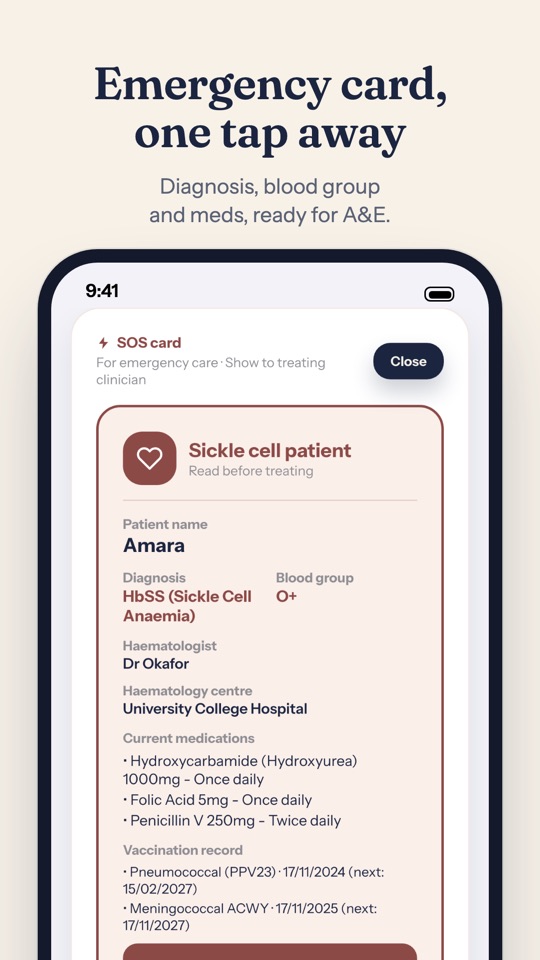
Set up your emergency card now
It takes about five minutes, and you'll have it when you need it. Free, with no account needed to try it.
Open myCrescentQuestions
How quickly should I get pain relief in A&E with a sickle cell crisis?
In England, NICE guidance says pain relief should be offered within 30 minutes of arriving at hospital, with pain checked every 30 minutes until it is under control. In the US, the American Society of Hematology recommends assessment and pain relief within one hour of arriving at the emergency department.
Should I take painkillers before going to hospital?
Follow your personal care plan. Whatever you take, write down what it was, the dose and the time, and tell the triage nurse, so the team can safely decide what to give you next.
What if the staff don't know much about sickle cell?
Show your care plan and emergency card, and ask for the haematology team to be told you are there. Most hospitals have a haematologist on call who can advise the emergency team.
Sources
- NICE. Sickle cell disease: managing acute painful episodes in hospital (CG143).
- Brandow AM et al. American Society of Hematology 2020 guidelines for sickle cell disease: management of acute and chronic pain. Blood Advances, 2020.