How to keep a sickle cell pain diary
Most sickle cell pain is managed at home, so it never appears in your hospital notes. A pain diary is how your haematology team gets to see the rest of the picture.
Why keep a pain diary?
In the PiSCES study, 232 adults with sickle cell disease kept a daily pain diary for up to six months. They reported pain on more than half of all days (54.5%), but used hospital or urgent care on only 3.5% of days. Most sickle cell pain is managed at home. Without a diary, your team only sees the small part that ended in hospital.
A diary helps you:
- Spot your triggers. Patterns such as cold snaps, poor sleep or a heavy week at work only show up over months.
- Make clinic time count. "Four crises since March, two after travelling" is more useful than "a few bad patches".
- Shape your care plan. How often and how badly you have pain is part of how your team judges whether a treatment such as hydroxyurea is working.
- Back up time off. Dated records help when you need a letter for work, school or university.
What to record for each crisis
- When it started and how long it lasted. Note the date and time it began, and when it eased.
- How bad it was. Your worst pain score on a 0 to 10 scale.
- Where it hurt. Back, chest, arms, legs, joints, tummy. Chest pain matters especially (see below).
- What might have triggered it. Cold, getting wet, dehydration, an infection, stress, overexertion, alcohol, or nothing obvious.
- What you took and whether it helped. Each painkiller, the dose and the time, so the next team can see what you have already had.
- Where it was managed. At home, at a day unit or in hospital, and how long you waited for pain relief if you went in.
- Anything else unusual. A temperature, feeling breathless, yellow eyes (jaundice) or unusual tiredness.
Between crises, a quick daily note of pain, energy and how much you drank fills in the gaps.
Keeping a pain diary in myCrescent
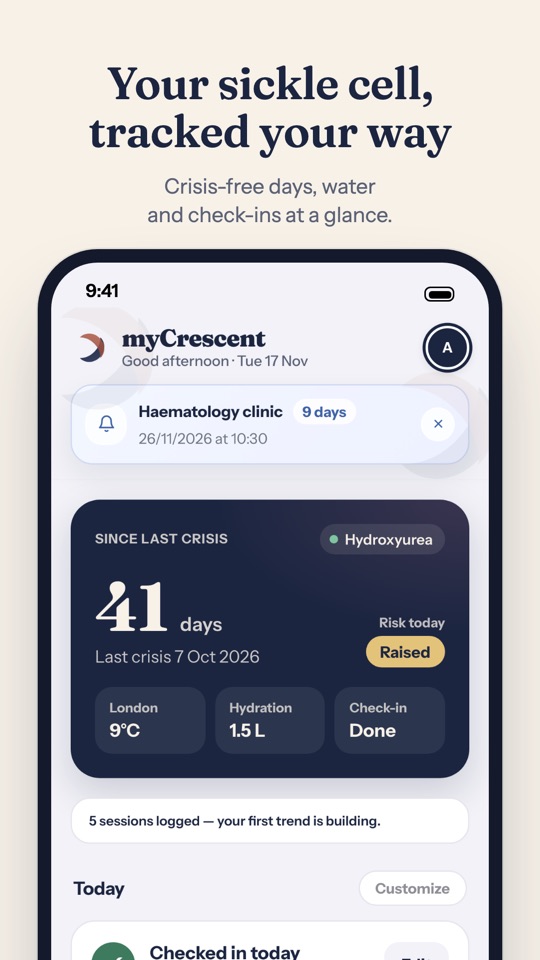
myCrescent's crisis log asks for each of the items above in a couple of taps: date and time, pain score, body locations, triggers, duration, where it was managed and any rescue medicine. It also asks about temperature, breathlessness and jaundice. Daily check-ins cover pain, energy and hydration.
Your home screen counts crisis-free days. Your history shows which triggers come up most, and you can print or save a summary as a PDF for clinic.
Start your pain diary today
Free, works in any browser, and no account needed to try it.
Open myCrescentQuestions
What pain scale should I use?
Most people use 0 to 10, where 0 is no pain and 10 is the worst pain you can imagine. The scale matters less than using the same one every time, so entries can be compared.
How often should I fill in a pain diary?
Log every crisis, and add a short daily check-in if you can. Pain days that never become a crisis are part of the picture too, and a check-in takes about ten seconds.
Should I share my pain diary with my doctor?
Yes. Bring it to haematology appointments. A summary of how many crises you had, how long they lasted and what seemed to trigger them helps your team decide whether your care plan or treatment should change.
Is a paper diary as good as an app?
A paper diary you actually keep is better than an app you don't. An app adds reminders, charts and a printable summary, and it is always on your phone when a crisis starts.
Sources
- Smith WR et al. Daily assessment of pain in adults with sickle cell disease. Annals of Internal Medicine, 2008;148(2):94–101.
- NICE. Sickle cell disease: managing acute painful episodes in hospital (CG143).